${ searchTerm }
${ searchTermSuggestion }

No product results found

Popular Searches
  • logo
  • logo
There are no items in your cart
  • logo
  • Items (${ cartItemsCount })
    ${ subTotal }
    Subtotal

    Contract market and A&D professionals?

    Go to our dedicated space for contract professionals, designed to streamline projects with accurate pricing, assets, and resources.

    confirm your purpose:
    Select country

    our guess is, you're located in

    Amalie and Flora first met while working at a small farm shop in Copenhagen, where their conversations circled around spices, and the way ingredients hold stories. That shared curiosity has since evolved into a food studio focused on catering and collaboration. They now work closely with museums, artists, and institutions, exploring food as an artistic medium and a tool for togetherness. 

    “We both came from academic backgrounds—me in food history and Flora in philosophy and modern culture,” Amalie explains. “But we both felt the urge to get closer to the craft itself. To cook, touch, taste, and smell the stories we were studying.” Their shared studio is as much about community as it is about cuisine.

    “We’re not just making dishes—we’re telling stories through food,” Flora adds.

    Setting the festive table 

    For the festive season, Amalie and Flora embrace what they call a sense of “modern tradition” — a gentle reworking of holiday classics. As Amalie reflects, there’s something beautiful about tradition; it’s what gives meaning to gatherings and shared rituals.

    Setting the table is about creating warmth — through candlelight, natural materials, and tactile fabrics that invite a feeling of ease and connection. They also often work with textile designers and use different fabrics like linen and wool to add warmth and texture to the table.

    “Candlelight is essential. Especially in winter—it creates such a calm, intimate mood,” says Amalie.

    For a playful touch, they suggest making candleholders out of apples or potatoes. “You just slice the bottom so they stand, carve a little space on top, and place the candle. Kids love it, it’s still food, but now it’s part of the setting, says Amalie. Their apple centerpiece reflects the same thinking. “It’s playful, but it’s also a reminder to really look at food. A vegetable or a piece of fruit is already a work of art.”

    Guests are invited to bring something from the garden, a leaf, a fruit, something they’ve found. “When you bring that to the table, you’re inviting nature in,” Flora adds.  

    Tradition, reimagined 

    For Amalie and Flora, it is equally about creating space for the present moment—lighter gatherings, more inclusive choices, and seasonal ingredients used with a new perspective. 

    In their holiday table, Amalie and Flora highlight three festive dishes to take center stage: almond cookies filled with quince jam, a warm spiced wine with a modern twist, and a sculptural arrangement of tiny Danish apples. 

    Almond cookies with quince jam 

    A favorite reimagined with a forgotten fruit.

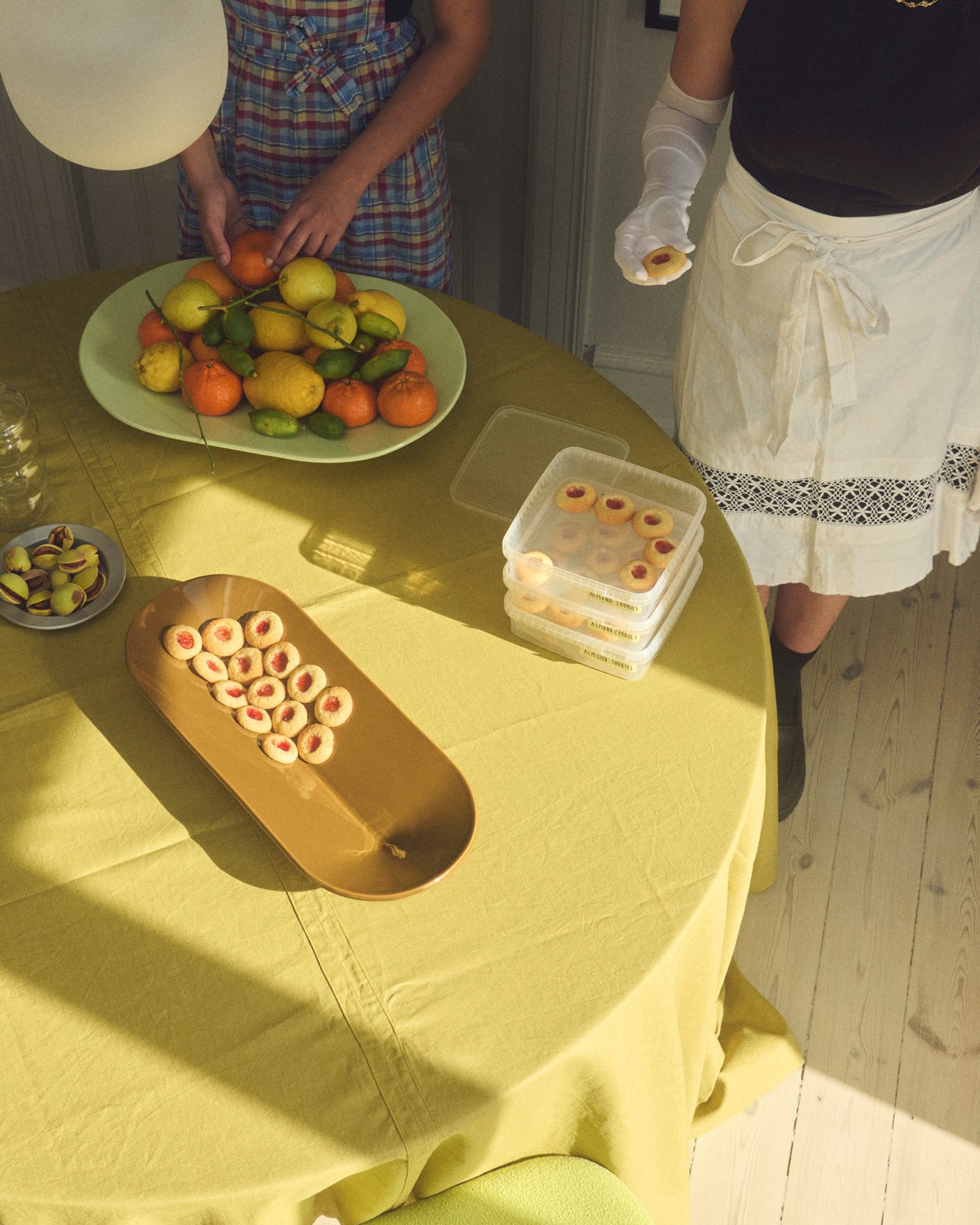
    In Amalie’s family, cookie season starts with a vote. “We each campaign for our favorites, and the top three get made, it taught me early that if you want to be heard, you have to vote,” she laughs. The cookies featured here reinterpret that tradition with the use of quince, a soft, fragrant fruit once common in Nordic kitchens, now rarely used. 

    Paired with almonds, vanilla, and just the right amount of sugar, these cookies feel comforting but subtly new.  

    “The quince jam adds this beautiful rose-red center,” says Flora. “It’s a natural way to introduce color and freshness without overwhelming sweetness.”
    Holiday moment featuring a recipe for almond cookies presented with the Muuto Mere Bowl, styled in a warm and inviting setting with seasonal details.
    Almond Cookies with Quince Jam

    Total time: 70 minutes 
    Active time: 25 minutes 
    Chill time: 30 minutes 
    Yield: Approx. 20 cookies 


    Ingredients 

    — 125 g butter 

    — 125 g sugar 

    — 1 vanilla pod (seeds scraped out) 

    — 1 egg yolk 

    — 175 g all-purpose flour 

    — 50 g almonds, finely ground 

    — 1 tsp baking powder 

    — Pinch of salt 

    — 1 tbsp of water 

    — 4 tablespoons quince jam 


    Method 

    Whip the butter and sugar until light and fluffy. 

    In a separate bowl, mix all the dry ingredients: flour, baking powder, salt, ground almonds, and mix well. 

    Stir the dry mixture into the butter mixture until the texture becomes crumbly. 

    Add the heavy cream and knead the dough briefly until it becomes smooth. 

    Roll small balls of dough (about 15 g each) and place them on a baking tray lined with parchment paper. 

    Use the rounded end of a wooden spoon to press a small indentation into each ball. 

    Fill each indentation with a little bit of quince jam. 

    Bake in a preheated oven at 180°C (350°F) for about 15–18 minutes until golden. 

    Let the cookies cool for 10 minutes on the tray before transferring to a wire rack to cool completely. Avoid overbaking. 

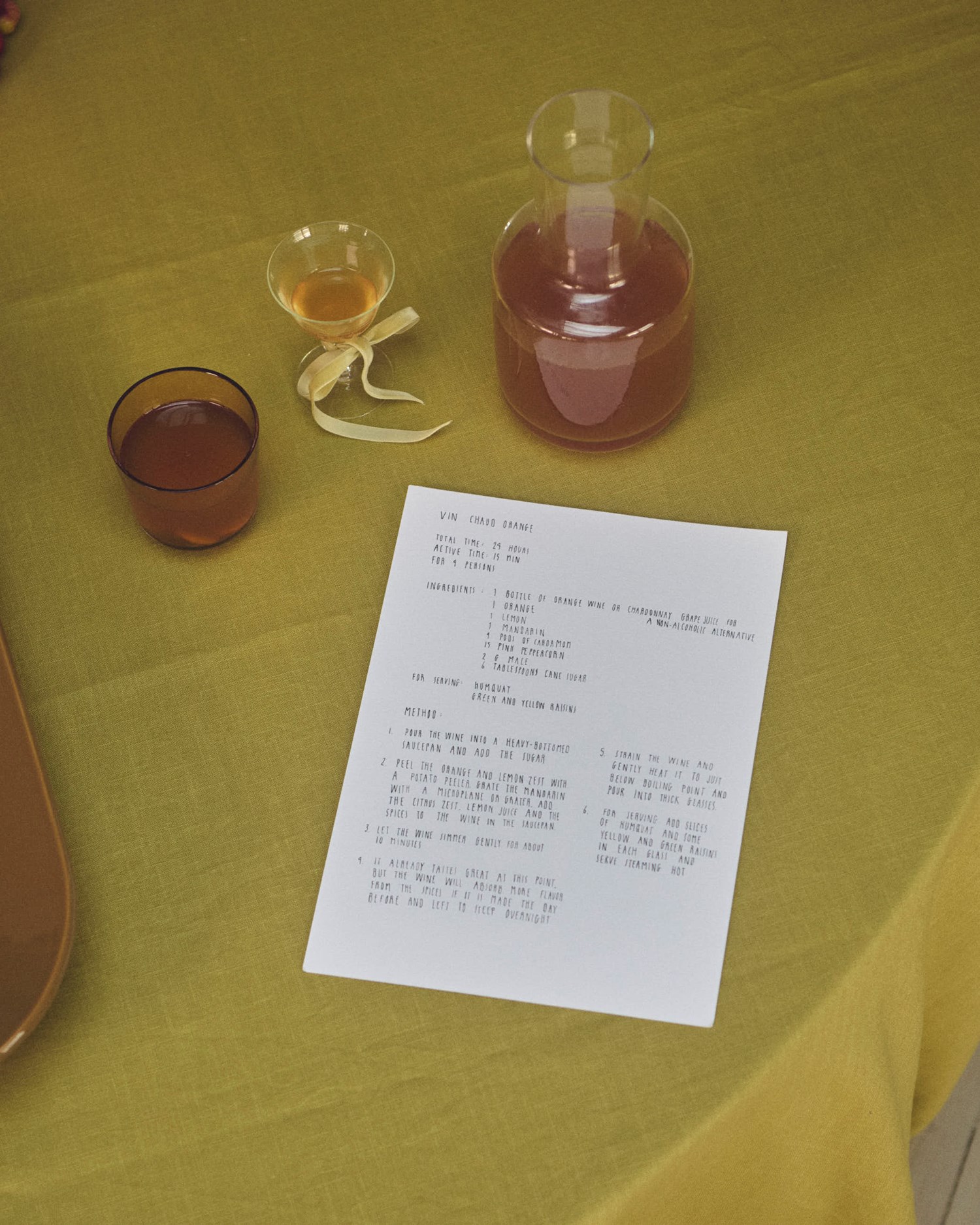
    Holiday recipe for vin chaud with orange, presented alongside the Muuto Raise Carafe and 
Glass in a warm setting with soft lighting and festive touches.

    Vin Chaud Orange 

    A lighter take on spiced wine for modern gatherings.

    A centerpiece of many winter tables, mulled wine has long marked the season with its warmth and spice. Amalie and Flora’s version keeps the essence, but softens the heaviness.

    “We created both an alcoholic and a non-alcoholic version, using Chardonnay grape juice for the latter,” says Amalie. “It still smells like winter—cinnamon, orange peel, cardamom—but it’s something everyone can enjoy. That’s the modern version of tradition for us.”

    Served warm with slices of raisin and preserved fruit, this is the kind of welcome drink that opens up a room. “I love that you can serve something festive that doesn’t need to be wine,” Flora adds. “It’s about inclusion—and a bit of surprise.”

    Vin Chaud Orange (Non-alcoholic version of mulled wine)

    Total time: 25 minutes 
    Active time: 15 minutes 
    For: 4 servings 


    Ingredients 

    — 1 bottle of orange wine or Chardonnay grape juice (for a non-alcoholic alternative) 

    — 1 orange 

    — 1 lemon 

    — 1 cinnamon stick 

    — 1 star anise 

    — 2 pcs cardamom 

    — 2 pcs pink peppercorn 

    — 1 tablespoon cane sugar 


    For serving: 

    — Kumquat 

    — Green and yellow raisins 


    Method 

    Pour the wine into a heavy-bottomed saucepan and add the sugar. 

    Peel the orange and the lemon. 

    Press the peels (and lemon juice) with your hands to release the aromas into the pot. Add the remaining peel, the citrus fruit, lemon juice, and the spices into the wine and heat slowly. Simmer for about 10 minutes. 

    Let the ingredients infuse for about 10 minutes. 

    Strain the wine and gently heat it to just below boiling. 

    Pour into thick glasses and add honeyquats and slices of green and yellow raisins in each glass. Serve instantly. 

    Products shown

    Related articles

    ${contentData.headline}

    ${contentData.items}

    part of the MillerKnoll Collective